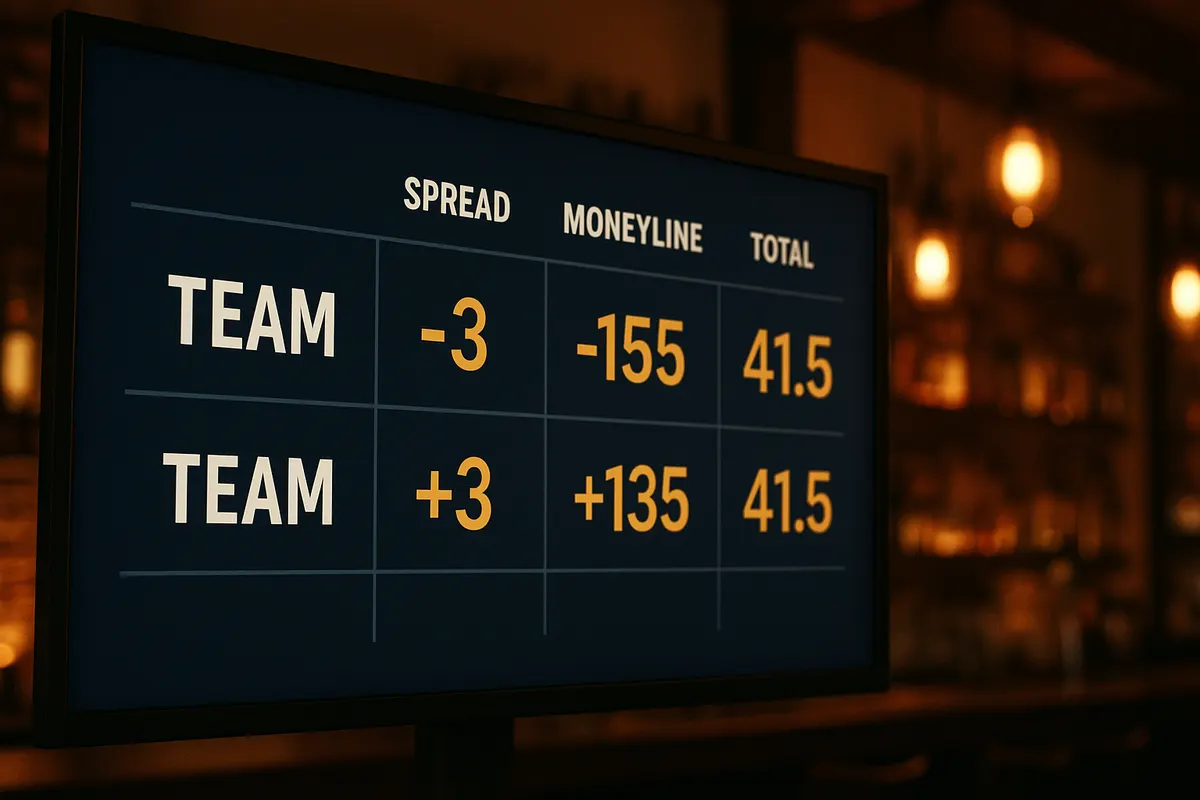
Case Keenum, 38 years old, third on the Chicago depth chart and without a start since 2023, is warming up at Soldier Field. Caleb Williams is out with a hamstring injury. The Philadelphia Eagles arrive 2-0 but scruffy, having needed a late touchdown to squeeze past Tennessee, and they are missing Dallas Goedert. Kickoff is 8:15 ET on ESPN. And the market’s verdict on all of that chaos is a single tidy string of numbers: Eagles -3.5, Philadelphia -186, total 41.5.
Here is the thesis worth holding on to before you read another line: those numbers are prices, not predictions. Understanding how NFL betting odds work means understanding that a sportsbook is not telling you who will win. It is telling you what each outcome costs, and quietly taking a cut for making the market. Once you read odds as prices, the whole board stops looking like code.
How NFL betting odds work: the three numbers on every line
Almost every NFL game is sold three ways, and a Monday Night Football screen will show all three side by side:
- Point spread — a handicap applied to the stronger team so both sides of the bet are roughly equally attractive.
- Moneyline — a straight bet on who wins, with the payout adjusted to reflect how likely each team is to do it.
- Total (over/under) — a bet on the combined points scored by both teams, ignoring who wins.
Each of these carries an implied probability. The Eagles at -186 imply roughly a 65% chance of winning; the Bears at +186 imply about 35%. Those percentages are where the money went, filtered through the book’s own risk management. They are not fact, and every one of these bets has a negative expected value over time because of the margin built into the price.
Point spread explained: what Eagles -3.5 means
The spread exists because “Eagles beat Bears” is a boring bet. Handicap Philadelphia by 3.5 points and suddenly both sides are a coin flip, which is exactly what a bookmaker wants.
Reading the spread number
The minus sign always sits with the favourite. Eagles -3.5 means Philadelphia starts the game 3.5 points in the hole for betting purposes. Chicago is +3.5, so the Bears begin with a 3.5-point head start.
Settle it by doing the arithmetic on the final score:
- Eagles win 27-20 (margin 7) → subtract 3.5 → Eagles “win” the bet by 3.5. Backers of -3.5 collect.
- Eagles win 20-17 (margin 3) → subtract 3.5 → Eagles lose by half a point. Chicago +3.5 collects, even though the Bears lost the actual game.
- Bears win outright by any score → Chicago +3.5 collects comfortably.
That half point is deliberate. It is called the hook, and it removes the possibility of a tie. If the line were Eagles -3 and Philadelphia won by exactly 3, the bet would be a push and stakes get refunded. With -3.5, someone always wins. A spread of, say, -7.5 works identically, just with a bigger handicap: the favourite would need to win by eight or more.
Covering versus not covering
“Covering the spread” simply means beating the handicap. A team can cover while losing (Chicago losing 24-21 covers +3.5) and fail to cover while winning (Philadelphia winning 17-16 does not cover -3.5). This is why spread bettors care about garbage-time field goals that nobody else in the stadium cares about.
The spread price on this game was -104 on the Philadelphia side, close to even money. Most traditional sportsbooks price spreads at -110 on both sides instead, which I will come back to.
Moneyline vs spread: paying for certainty
The moneyline drops the handicap entirely. Pick the winner, that’s it. The trade-off is that the payout, not the margin of victory, does the balancing.
Favourite and underdog odds
American odds use a plus or minus sign around a base of 100 units.
- Negative number (favourite): how much you must stake to profit 100. Philadelphia at -186 means ₹186 risked to win ₹100.
- Positive number (underdog): how much profit 100 units of stake returns. Chicago at +186 means ₹100 risked to win ₹186.
Indian sportsbooks usually display decimal odds instead, which many readers will find friendlier: -186 converts to about 1.54, and +186 to about 2.86. Decimal odds include your stake, so 2.86 means a ₹1,000 bet returns ₹2,860 in total.
Calculating moneyline payouts
The formulas are short. For negative odds: profit = stake × (100 ÷ odds). For positive odds: profit = stake × (odds ÷ 100).
| Bet | American odds | Decimal | ₹1,000 stake returns | Implied probability |
|---|---|---|---|---|
| Philadelphia to win | -186 | 1.54 | ₹1,537 (₹537 profit) | ≈65% |
| Chicago to win | +186 | 2.86 | ₹2,860 (₹1,860 profit) | ≈35% |
Implied probability comes from the odds themselves. For a favourite: odds ÷ (odds + 100), so 186 ÷ 286 = 65%. For an underdog: 100 ÷ (odds + 100), so 100 ÷ 286 = 35%.
The practical difference between moneyline and spread is what you are buying. The moneyline asks less of the Eagles (win by a single point and it pays) but pays less for the privilege. The spread demands a four-point win and rewards you near even money. Neither is smarter than the other; they are different prices for different questions.
Monday Night Football odds on points: the over/under total
The total for this game sat at 41.5 points. That figure is the combined score of both teams, and nothing else about the result matters.
- Final score 24-20 → 44 points → over 41.5 wins.
- Final score 17-13 → 30 points → under 41.5 wins.
- A 41-point game? The half point means there is no push. Under wins.
Both offences feed the same number, which is why a total says something about the whole game rather than either team. A third-string quarterback making his first start in two years, an Eagles offence missing its main red-zone target, a Chicago game plan leaning on D’Andre Swift and the run: all of that pushes and pulls on one figure.
Books also price team totals, and they show you the maths behind the main number. Philadelphia over 23.5 and Chicago over 18.5 add up to 42, sitting right on top of the 41.5 game total. That consistency is not a coincidence, it is the model.
NFL odds reading: the whole line at a glance
Put the three markets together and a full Monday Night Football line looks like this.
| Team | Spread | Moneyline | Total |
|---|---|---|---|
| Philadelphia Eagles | -3.5 (-104) | -186 | Over 41.5 (+100) |
| Chicago Bears (home) | +3.5 | +186 | Under 41.5 |
Read it left to right and it translates into plain English: the market expects Philadelphia to win by about three and a half points, gives them roughly a 65% chance of winning outright, and expects a little over 41 combined points. The home team is conventionally listed second or marked with a “vs”, and the number in brackets next to a spread or total is the price attached to that specific side.
Worth noting: the figures above came from a prediction market’s pricing, where both sides of the spread were near even money. At a conventional sportsbook you would typically see -110 in those brackets instead. Same line, slightly different cost.
Juice and vig: why nothing is priced at 50/50
If a spread were a true coin flip, fair odds would be +100 on both sides: risk ₹1,000, win ₹1,000. You will almost never see that. The standard price is -110 each way, which is the juice, also called the vig.
At -110 you risk ₹1,100 to win ₹1,000. The implied probability is 110 ÷ 210 = 52.38% per side. Add both sides and you get 104.76%, and that extra 4.76% is the book’s overround, its margin for hosting the bet. The consequence is concrete: you need to win about 52.4% of your -110 bets just to break even, not 50%. Win exactly half and you lose money slowly and steadily.
The same margin hides inside moneylines. Philadelphia’s 65% and Chicago’s 35% happen to sum to 100% in the prices quoted above, but a typical sportsbook will shade both sides, perhaps -200 and +170, so the total tips past 100% again. That gap is the house edge, and it is the honest answer to why sportsbooks profit over the long run regardless of who covers.
Common questions about reading NFL odds
How do NFL point spreads work?
The favourite is handicapped by the spread number and the underdog is credited with it. Eagles -3.5 must win by four or more; Bears +3.5 need to win or lose by three or fewer.
What does moneyline mean?
A bet on the outright winner, with no handicap. Payouts differ by side: the favourite pays less than your stake in profit, the underdog pays more.
What is the total in NFL betting?
The combined points scored by both teams. You bet over or under the posted number, in this case 41.5.
Does overtime count?
At most sportsbooks, spreads and totals settle on the final score including overtime, but terms vary by operator, so check the rules on the specific market before you stake anything.
One last practical point. Odds tell you price and implied probability, never certainty, and the vig guarantees the operator an edge over time. If you do bet, treat it as paid entertainment: set a deposit or loss limit before you start, use the cool-off and self-exclusion tools your sportsbook provides, and never stake money you need for something else. Betting winnings are taxable in India, so keep your own records. There is no single minimum betting age across India: legality and the applicable minimum age depend on your state and on whether the activity is treated as a game of skill or a game of chance, so check the rules that apply where you live and the operator’s own terms before you stake anything. And if it stops feeling like a game, stop and seek support.