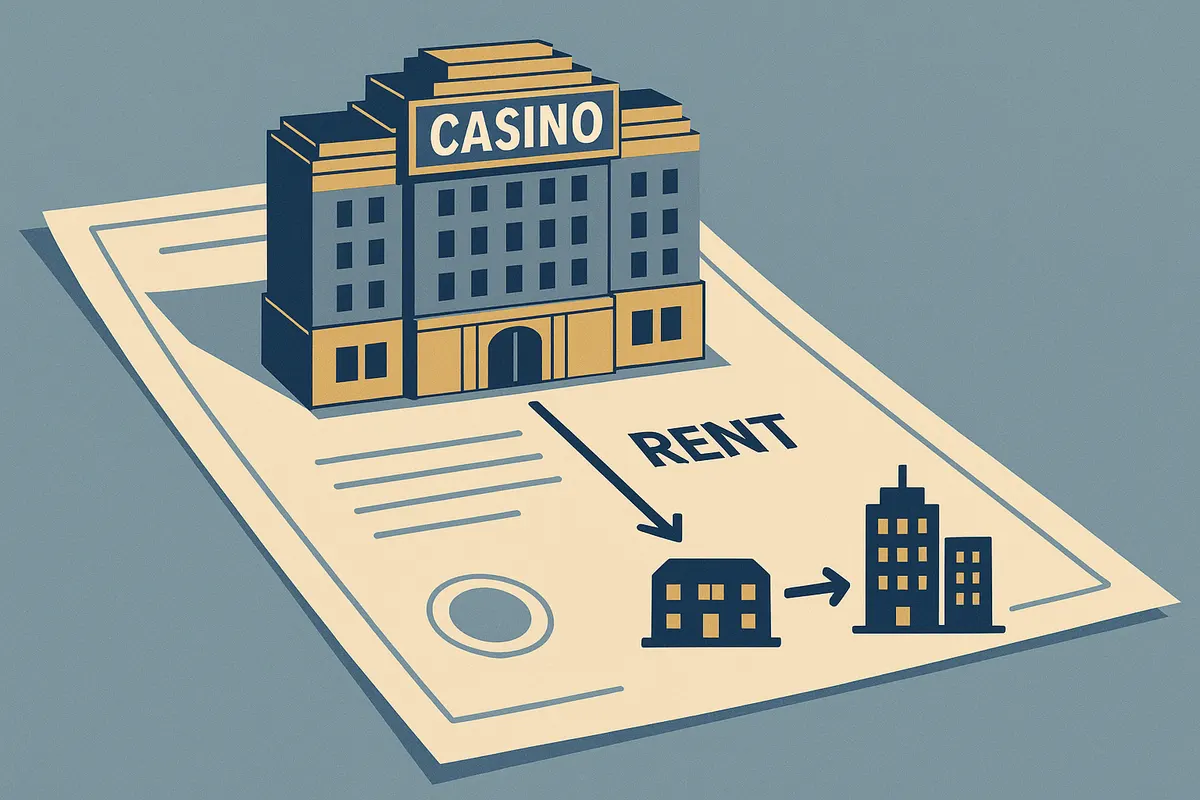
A casino real estate investment trust is a landlord that owns casino buildings and land but never deals a single hand of blackjack. That is the one-line version. The moment you look at an actual transaction, it gets more interesting, because the REIT often keeps the building while the casino operator on the lease changes entirely.
That is exactly what happened in Alberta. VICI Properties signed a fresh 20-year triple net lease with Highfield Investment Group covering the real estate at Century Mile and Century Downs racetracks, after Century Casinos sold the racetrack operations to Highfield. The bricks did not move. The tenant did. If you understand why that was possible, you understand the whole OpCo/PropCo model.
What a casino real estate investment trust actually is
A gaming REIT buys the physical property under casinos, racetracks and resorts, then leases it back to licensed operators on very long contracts. Its revenue is rent, not gaming revenue. It has no table limits, no slot floor, no player database and, critically, usually no gaming licence of its own.
The REIT rulebook in plain terms
A real estate investment trust is a tax structure before it is anything else. In the US, a REIT must hold mostly real estate assets, earn most of its income from rent or property interest, and distribute at least 90% of its taxable income to shareholders. In exchange, it avoids corporate income tax on what it pays out. You can read the technical definition at Nareit, the US REIT industry body.
That structure is the reason the model looks the way it does. A REIT cannot run an operating business inside itself without wrecking its income tests, and a gaming regulator would have plenty to say about an untested landlord taking over a casino floor. So the REIT collects rent and stays out of operations.
Why gaming property is its own asset class
An office REIT owns buildings any tenant can use. A gaming REIT owns buildings that are near useless to anyone without a casino licence. That single fact shapes everything:
- Tenant pool is tiny. Only licensed operators can use the asset as intended, so re-tenanting is a regulatory exercise, not a leasing one.
- Leases are enormous. Initial terms of 15 to 30 years with multiple renewal options, versus three to ten years for most commercial space.
- Rent is mission critical. The tenant cannot relocate. Moving a casino means reapplying for everything.
- Concentration is normal. A handful of large operators account for most of the rent roll, which is a strength when they trade well and a problem when they do not.
The Alberta racetrack deal, line by line
The Alberta agreement is a useful teaching case because it is not a straightforward sale-leaseback. VICI already owned the real estate at Century Mile and Century Downs through its existing Century Casinos master lease. Century decided to exit the racetrack operating business and sold those operations to Calgary-based Highfield Investment Group. VICI then documented a new lease directly with the incoming operator.
| Term | Detail |
|---|---|
| Landlord / tenant | VICI Properties / Highfield Investment Group |
| Properties | Century Mile and Century Downs racetracks, Alberta, Canada |
| Lease type | Triple net |
| Initial term | 20 years, with four five-year renewal options |
| Starting base rent | CAD$10.7 million per year (about US$7.5 million) |
| Rent escalator | Greater of 1.25% or Canadian CPI, capped at 2.50% |
| Capital spending | Minimum capex equal to 1% of annual net revenue at each property |
| Expected close | Q4 or Q1 2027, subject to conditions and regulatory approvals |
Now the clever part. VICI agreed to cut the rent under its existing Century master lease by the same CAD$10.7 million. Total rent to VICI does not change. It swapped one tenant’s obligation for another’s at identical value, while Century shed a business it no longer wanted and reduced its lease burden. VICI’s president and COO John Payne framed it as supporting a tenant’s long-term strategy and helping deleverage the Century balance sheet. Highfield’s president Adrian Munro talked about modernising the racetracks.
Read that as the model working as designed: the landlord’s cash flow is insulated from one operator’s strategic retreat, because the asset itself still has value to somebody who wants to run it.
How a casino sale-leaseback works
A casino sale-leaseback is a two-part transaction that happens simultaneously. The operator sells the land and buildings to the REIT for cash, then signs a lease to keep occupying and running the same property. Nothing changes for the player walking in. Everything changes on the balance sheet.
The sale
Pricing is driven by rent, not by construction cost. The parties agree what annual rent the property can sustainably support, then apply a capitalisation rate to arrive at the purchase price. A property that can carry $40 million of rent at a 7% cap rate is worth roughly $571 million to the buyer. The operator receives that cash at closing and typically uses it to repay debt or fund something else.
The leaseback
Almost every gaming lease is triple net, which means the tenant pays property taxes, insurance and maintenance on top of rent. The landlord’s cheque arrives before any of those costs, which is why REITs quote such clean margins. Initial terms run long, renewal options extend them further, and many large portfolios sit under a single master lease so the operator cannot cherry-pick which properties to keep paying for.
What the rent really costs
Rent escalators decide how expensive the deal becomes over time. The Alberta lease grows by the greater of 1.25% or Canadian CPI, capped at 2.50%. At the 1.25% floor, CAD$10.7 million becomes roughly CAD$13.7 million by year 20. At the 2.50% cap, it is closer to CAD$17.5 million. The cap protects the tenant in a high-inflation decade; the floor protects the landlord in a flat one.
The rest of the lease is where tenants get squeezed. Rent is usually an absolute obligation regardless of trading conditions. Coverage covenants set a minimum ratio of property cash flow to rent. Minimum capex requirements, 1% of annual net revenue in the Alberta case, force the tenant to keep reinvesting so the asset does not decay on the landlord’s watch.
Why operators hand over the keys to the building
Owning a casino building ties up enormous capital in an asset that earns nothing by itself. The gaming REIT explained simply: it is a way to convert that dead equity into cash while keeping the licence, the brand, the staff and the customers. The usual motivations:
- Real estate monetisation. Property typically trades at a higher multiple as rented real estate than as part of a gaming company’s enterprise value. Selling can capture that gap.
- Deleveraging. Sale proceeds pay down expensive debt. That was the stated benefit for Century in Alberta.
- Asset-light operations. Capital shifts from buildings to what actually generates margin: gaming, food and beverage, hotel, marketing.
- Expansion funding. One sale can bankroll acquisitions or new market entries without issuing equity.
- Risk transfer. Long-term ownership risk on a single-purpose building moves to a specialist that holds many of them.
There is a cost, and it is permanent. You swap a mortgage that eventually ends for a rent bill that does not. If you are modelling this, compare the after-tax cost of the debt you retire against decades of escalating rent, and stress test both against a recession year.
VICI Properties and how it got so big
VICI Properties is the largest gaming REIT and the reference point for the whole sector. It was created in 2017 out of the restructuring of Caesars Entertainment Operating Company, which is why Caesars has always been its anchor tenant, and it later absorbed MGM Growth Properties to become the landlord under much of MGM’s Las Vegas portfolio too. It owns the real estate beneath marquee Strip assets including Caesars Palace, the Venetian Resort and MGM Grand, plus dozens of regional casinos and racetracks across the United States and Canada.
Its business model has three moving parts: buy gaming real estate, lease it on very long triple net terms with contractual escalators, and act as a capital partner when tenants need funding for development or acquisitions. Gaming and Leisure Properties, spun out of Penn National in 2013, pioneered the structure; VICI scaled it.
Worth noting for readers in India: nothing equivalent exists here. India’s REIT market, regulated by SEBI and open since Embassy Office Parks listed in 2019, is built on offices, retail and warehousing. Licensed casino floors are concentrated in Goa, Sikkim and Daman, often aboard vessels or inside hotels the operator already owns, so there is no pool of standalone gaming real estate to securitise. Indian listed gaming companies remain asset-heavy by structure, not by choice. Our gaming industry analysis section tracks how those balance sheets compare with asset-light international peers.
Where the OpCo/PropCo model helps and where it bites
The OpCo/PropCo structure splits one company into an operating business and a property business. Each side gets something real, and each accepts something uncomfortable.
What the operator gets
Immediate cash, a lighter balance sheet, and return on capital ratios that look far better once billions of property assets leave the books. Management gets to focus on running casinos rather than maintaining roofs and car parks. Growth becomes cheaper, because the REIT will often fund the real estate portion of a new acquisition.
What the REIT gets
Contracted rent for 20 years or more with built-in escalators, minimal operating costs thanks to triple net terms, tenants who physically cannot move, and a regulatory barrier that keeps casual competitors out of the asset class.
The drawbacks nobody advertises
| Risk | Who carries it | Why it matters |
|---|---|---|
| Fixed rent in a downturn | Operator | Revenue falls, rent does not. Operating leverage cuts both ways. |
| Loss of asset upside | Operator | Land appreciation and redevelopment gains accrue to the landlord. |
| Lease restrictions | Operator | Capex minimums, coverage covenants and consent requirements limit flexibility. |
| Tenant concentration | REIT | A few large operators drive most of the rent roll. |
| Single-purpose assets | REIT | Re-tenanting needs a licensed replacement, as the Alberta deal shows. |
| Interest rates | Both | Higher rates raise the REIT’s cost of capital and compress acquisition economics. |
The Alberta transaction is a fair snapshot of the balance. Century wanted out of the racetrack operating business, Highfield wanted in, VICI kept the land and the rent, and the closing still waits on regulatory approval. The landlord’s cash flow held steady because someone else was willing to take the licence and the lease. When that is not true, the whole structure is only as strong as the tenant standing on the floor.
This article explains business mechanics and is not investment advice. If you also play at casinos, treat gambling as entertainment with a built-in house edge, set deposit and loss limits in advance, and use self-exclusion tools if play stops being fun.